
For many Filipino teachers, the interview is the final hurdle between “dreaming about teaching in America” and actually receiving that job offer. Yet even the strongest, most experienced teachers often fall into the same interview traps and mistakes—not because they lack skill, but because the U.S. interview culture is very different from what we’re used to in the Philippines.
If you’ve attended interviews and felt confident but still didn’t receive an offer, this article will help you understand why.
These are the most common Filipino teacher mistakes during U.S. interviews—and how to avoid them.
1. Giving Long, Story-Based Answers Instead of Focused Responses
Filipino teachers love to explain context, background, and detail. But U.S. principals want answers that are:
- concise
- instructional
- result-driven
An effective interview response usually lasts 20–40 seconds.
Avoid:
“My teaching philosophy started when I was young… then in my previous school…”
Do instead:
“I use a student-centered approach by… This resulted in improved engagement and outcomes.”
Clarity beats storytelling.
2. Focusing on Effort Instead of Student Outcomes
In the Philippines, hard work is the badge of honor.
In the U.S., principals listen for impact.
Avoid:
“I work hard and love my students.”
Do instead:
“In my previous classroom, struggling readers improved by two grade levels after implementing targeted interventions.”
Impact wins interviews.
3. Using General Statements Instead of Specific Strategies
U.S. schools expect teachers to speak in terms of instructional strategies, frameworks, tools, and systems.
Avoid:
“I handle misbehavior by talking to the student.”
Do instead:
“I use proactive routines, non-verbal cues, PBIS-aligned reinforcement, and restorative conversations.”
Specificity signals readiness.
4. Not Connecting Your Answers to U.S. School Realities
Even without U.S. experience, principals expect awareness of:
- IEPs
- inclusion
- trauma-informed teaching
- high-needs populations
Avoid:
“We didn’t have IEPs in my previous school.”
Do instead:
“I am eager to support IEP goals and accommodations. In my previous setting, I adapted lessons for diverse learners by…”
Show adaptability—not inexperience.
5. Weak Classroom Management Responses
This is one of the top reasons Filipino teachers lose an offer.
U.S. principals want teachers who can:
- lead a structured classroom
- manage behavior consistently
- use data for behavior trends
- maintain safety
Avoid:
“I set expectations and talk to them.”
Do instead:
“I implement clear routines, proximity redirection, reinforcement systems, visual cues, and restorative conversations. I document patterns and adjust interventions as needed.”
A strong management system is non-negotiable.
6. Humble, Soft Responses That Undersell Your Capability
In Filipino culture, humility is expected.
In U.S. interviews, it can signal uncertainty.
Avoid:
“Maybe I can…”
“Hopefully I will…”
“I think I can try…”
Do instead:
“I will implement…”
“I am confident that…”
“My approach ensures…”
Confidence builds trust.
7. Not Practicing U.S.-Style Questions in Advance
U.S. interviews are scenario-based, technical, and structured. Filipino teachers often assume:
“I can answer if they ask me.”
But U.S. principals expect prepared responses to questions such as:
- “How do you support students with trauma?”
- “How do you differentiate lessons for struggling learners?”
- “How do you analyze student data?”
- “What does an inclusive classroom look like?”
Going in without structured responses is one of the fastest paths to rejection.
The Good News: All These Mistakes Are Fixable
You do not need U.S. experience.
You do not need to be a perfect teacher.
You simply need to communicate the U.S. way.
Once you shift how you answer, your chances of being hired increase immediately.
If You Want to Avoid These Mistakes, Start With This Guide
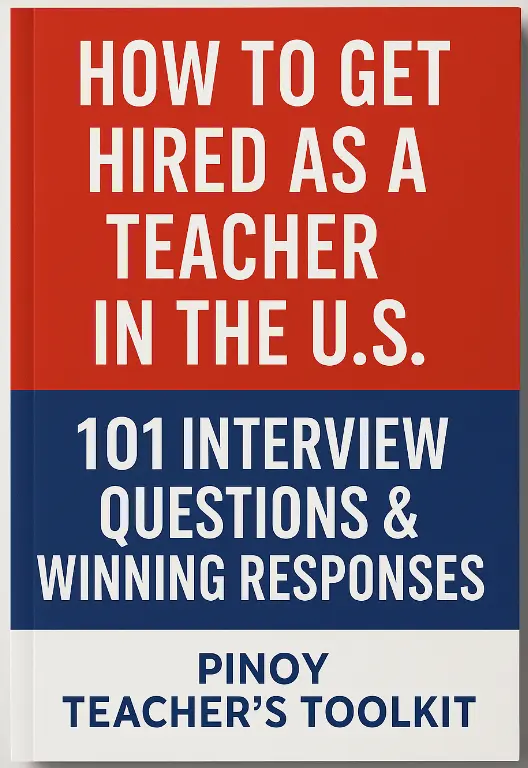
I created a resource specifically for Filipino teachers preparing for U.S. interviews:
101 Interview Questions & Winning Responses Guide
A step-by-step guide that shows you:
- what U.S. principals are actually listening for
- how to avoid common Filipino teacher mistakes
- how to answer clearly, confidently, and strategically
- sample responses you can adapt
- how to apply a U.S.-style interview framework
If you want to walk into your next interview prepared, focused, and confident, download your guide here:
https://teach-usa.myflodesk.com/101questions
This guide has helped many teachers go from overthinking to hired.
It can help you do the same.